
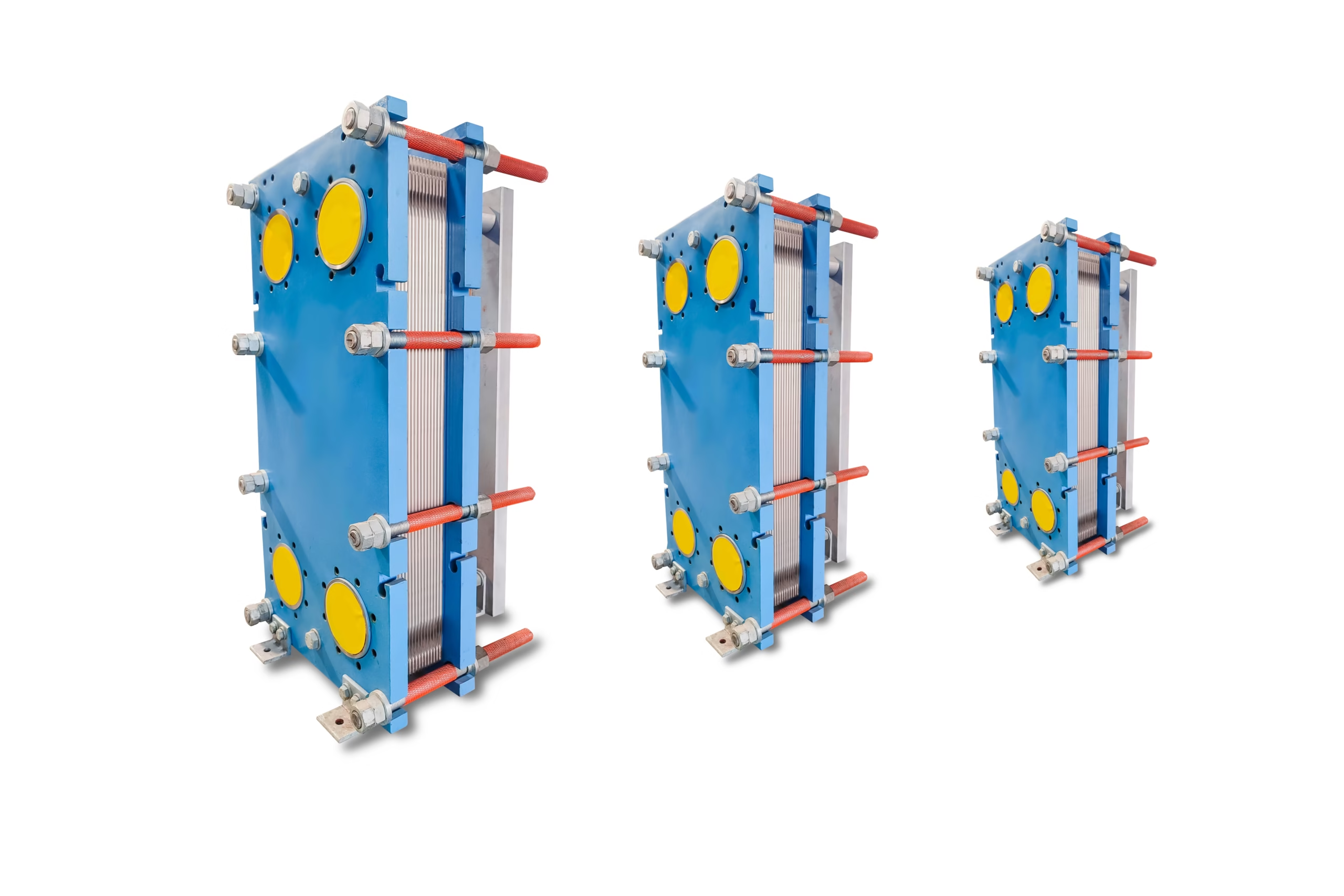
Heat Exchanger is a system or a device which is used to transfer heat from one medium to another medium.
Mainly we used three types of heat exchanger.
- Shell & Tube Heat Exchanger.
- Plate Type Heat Exchanger.
- Fin type Heat Exchanger.
Plate Heat Exchanger
It is a type of Heat Exchanger where we use metal plates to transfer heat from hot fluid to cold fluid.
There are mainly four types of plate heat exchanger.
- Gasketed Plate Heat Exchanger.
- Brazed Plate Heat Exchanger.
- Semi Welded Heat Exchanger.
- Welded Plate Heat Exchanger.
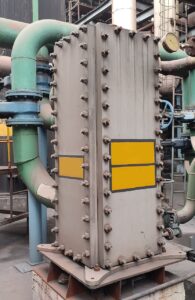
Gasketed Plate Heat Exchanger Construction
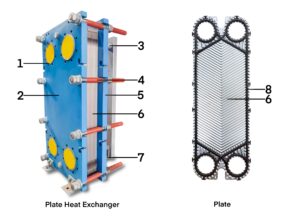
Plate Heat Exchanger Consist of several components as follow.
- Liner – Liner is use to avoid direct contact with fluid and fixed plate, It can be a metal lining or Rubber lining ( Same as heat exchanger gaskets material)
- Fixed Plate – It is a thick MS plate remain fixed with Heat Exchanger frame and giving support to Heat transfer plates and used to tightening the Plates with the help of bolts.
- Carrying Bar – It is metal bar or a tube used to hang the heat transfer plates on it, it helps to align the plates properly in Heat Exchanger.
- Tightening Bolt – It is long bolts use to tightening the plates in Heat Exchanger.
- Pressure Plate – It is a tick movable MS plate giving support to Heat transfer plates and use to tightening the Plates with the help of bolts.
- Heat Transfer Plate – It is the main component of a plate heat exchanger, it is a metal plate with corrugation and thickness can be 0.4mm to 0.8mm, it is transfer heat from one medium another medium without mixing the two medium. Plates makes channels where fluid flows.
- Guiding Bar- It is a metal bar or a tube used to guide the hanged plate on carrying bar and it also help to align the plates properly in Heat Exchanger.
- Gaskets – Each heat transfer plates fitted with a gaskets and it is used to seal the channels and give direction the fluid to alternate channels.
Heat Transfer Plate Material
Most of the cases SS316L is used but depending on application SMO, Nickel, Titanium, Alloy C276 is also have uses.
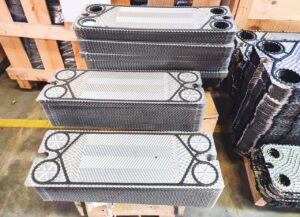
Gaskets Material
Most of the cases NBR is used but depending on application HNBR, EPDM, FKM, CR, PTFE, VITO, NBR-HT is also have uses.
Application of Plate Heat Exchanger
Plate Heat Exchanger have application is several industries like
- Steel Industry – Use is hydraulics oil cooling, water cooling.
- HVAC
- Food processing
- Power Generation
- Chemical Industry
- Oil & Gas
- Refrigeration
- Marine
- Pharmaceutical industry
Basic Knowledge of Gasketed Plate Heat Exchanger Maintenance
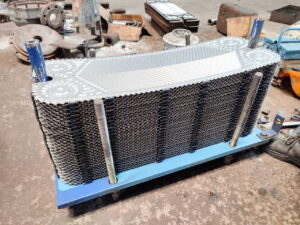
For Gasketed plate Heat Exchanger Maintenance following steps involve
- Need to measure plate pack length (Frame plate inner side to presser plate inner side length)
- Dismantle the Heat Exchanger and remove all plates.
- Remove gaskets from plates.
- Clean Heat Transfer plates properly, for different types of fouling need different types of chemical cleaning process. Chose chemical carefully otherwise it will damage the plates.
- Always avoid using steel wool or brush for plate cleaning, it can damage the plates.
- Apply gaskets again.
- Rearrange the plates and assemble the Heat exchanger.
- Maintain the plate pack length as befor.
For any type of help regarding Heat Exchanger you can Contact Us.
Advantages
- Plate Heat Exchanger is five times more efficient than a regular shell & tube heat exchanger, it can achieve very high delta T and it can work with very less approach temperature. Fluid flow through small corrugated channels and due to that fluid can achieve turbulent flow and mixed properly during flow.
- As per need we can adjust the capacity anytime by adding or removing the plates.
- Servicing is very easy, due to that it can maintain the efficiency for whole life.
- Price is low because it need very less raw material compare to a shell & tube heat exchanger.
- It’s size is very compact also need very less space for servicing.
Disadvantages
- Operating pressure is limited, standard operating pressure is 10 bar but it can go unto 15 bar in special cases.
- Due to use of gaskets operating temperature is limited.
- It is not suitable for gas applications.
- Due to small flow path it can choke easily.
- Pressure drop is higher than the shell & tube Heat Exchanger.
Q. In general case what Data Required to design a Plate Heat Exchanger?
- Hot Side Flow Rate – ?
- Hot side Inlet Temperature – ?
- Hot Side Outlet Temperature – ?
- Cold Side Flow Rate – ?
- Cold Side Inlet Temperature – ?
Q. What Is SS cladded Heat Exchanger?
In food industry, Heat Exchanger all MS components covered with SS sheet to avoid direct contact with MS, it is called SS cladded Heat Exchanger.
The plate heat exchanger is a crucial component in various industries due to its efficiency in transferring heat between fluids. Its design, utilizing metal plates, allows for effective heat exchange and adaptability to different applications. The choice of materials, such as SS316L or specialized alloys, ensures durability and compatibility with specific industrial needs. Regular maintenance is essential to keep the system functioning optimally and extend its lifespan. Why is material selection so critical in the performance of plate heat exchangers?
Wrong material selection will lead to heat exchanger failure and intermixing will happen.
The text provides a detailed overview of heat exchangers, particularly plate heat exchangers, and their applications across various industries. It mentions the materials used, such as SS316L, SMO, Nickel, and Titanium, depending on specific applications. The use of different gasket materials like NBR, HNBR, and EPDM is also highlighted, tailored to different operational needs. Additionally, the text explains the importance of SS cladding in the food industry to prevent direct contact with MS. How does the choice of material impact the efficiency and longevity of plate heat exchangers in different industrial applications?
Selection of material depends on application, plate and gasket material depends on hot and cold media and temperature.
Plate heat exchangers are essential in many industries due to their efficiency and versatility. The choice of materials like SS316L or specialized alloys ensures durability and compatibility with specific needs. Regular maintenance is crucial to maintain optimal performance and extend the lifespan of the system. The use of SS cladding in the food industry prevents contamination and ensures safety. Why is material selection so critical in the performance of plate heat exchangers?
Questa pagina rende possibile l’assunzione di lavoratori per attività a rischio.
Gli utenti possono trovare candidati qualificati per lavori una tantum.
Ogni candidato sono selezionati con severi controlli.
assumi assassino
Con il nostro aiuto è possibile ottenere informazioni dettagliate prima di procedere.
La professionalità è la nostra priorità.
Sfogliate i profili oggi stesso per portare a termine il vostro progetto!
Plate heat exchangers are indeed fascinating in their design and versatility. The use of metal plates for heat transfer seems efficient, but I wonder how they compare to other types of heat exchangers in terms of cost and maintenance. The variety of materials like SS316L and specialized alloys is impressive, but how do these choices impact the overall durability in extreme conditions? The mention of SS cladding in the food industry is crucial for safety, but are there any challenges in maintaining these cladded systems? Regular maintenance is essential, but what are the most common issues that arise over time? The text emphasizes material selection, but how does one determine the best material for a specific application? Overall, the adaptability of plate heat exchangers across industries is remarkable, but are there any limitations to their use in certain environments?
The explanation of plate heat exchangers is quite comprehensive, especially regarding material selection and their applications. It’s fascinating how the choice of materials like SS316L or specialized alloys can significantly impact performance and durability. The mention of SS cladding in the food industry is particularly interesting—it’s a smart way to ensure safety and hygiene. However, I’m curious about the specific challenges faced during the maintenance of gasketed plate heat exchangers. Are there common issues that arise, and how are they typically resolved? Also, how do industries decide between using NBR, HNBR, or other gasket materials? It seems like a critical decision that could affect the entire system’s efficiency. What’s your take on the balance between cost and performance when selecting these materials? Would love to hear more insights!
Plate heat exchangers are indeed fascinating in their design and versatility. The use of metal plates for heat transfer seems efficient, but I wonder how the thickness of these plates affects the overall performance. The variety of materials like SS316L and Titanium is impressive, but how do these choices impact the cost and maintenance of the system? It’s interesting to see how different industries adapt these exchangers, especially in the food industry with SS cladding. However, I’m curious about the environmental impact of these materials over time. Could there be more sustainable options that still meet the required standards? Lastly, the mention of regular maintenance is crucial, but what are the most common issues that arise if maintenance is neglected? Would love to hear more about real-world challenges and solutions in using plate heat exchangers.
Heat exchangers are indeed fascinating devices, and their role in various industries cannot be overstated. The use of metal plates for heat transfer seems efficient, but I wonder how they compare to other types of heat exchangers in terms of cost and maintenance. The emphasis on material selection is crucial, especially in industries like food processing where contamination must be avoided. I’m curious, though, how often do these systems require maintenance, and what are the most common issues faced? The mention of SS cladding is interesting—does this significantly increase the cost of the equipment? Overall, it seems like a well-thought-out system, but I’d love to hear more about its limitations or challenges in real-world applications. What’s your take on the future advancements in heat exchanger technology?
This explanation provides a clear understanding of plate heat exchangers and their versatility across industries. The emphasis on material selection, like SS316L and specialized alloys, highlights their importance for efficiency and durability. It’s interesting how gasket materials such as NBR or EPDM are tailored to specific needs, ensuring optimal performance. The mention of SS cladding in the food industry shows how practical considerations drive design choices. However, I wonder how often maintenance is required for these systems to prevent failures like intermixing? Also, are there any emerging materials or technologies that could further enhance the performance of plate heat exchangers? What’s your take on the potential for innovation in this field?
Plate heat exchangers indeed play a vital role in industrial applications, and their design seems well-thought-out for efficiency. The emphasis on material selection is crucial, as it directly impacts durability and compatibility with various fluids. I found it interesting how different alloys and gasket materials are tailored for specific applications, ensuring optimal performance. The mention of SS cladding in the food industry highlights the importance of hygiene and safety. However, I wonder if there are any significant limitations or challenges in the maintenance of these systems, especially in industries with strict regulations. Could improper maintenance lead to cross-contamination or efficiency loss? How do industries ensure consistent performance over time? Overall, the adaptability and precision in design make plate heat exchangers a fascinating subject. What advancements do you foresee in this technology to further enhance its application?
Как подчеркнуть свой вкус с помощью мебели премиум-класса.
Мебель премиум [url=http://www.byfurniture.by]http://www.byfurniture.by[/url] .
This is a very informative piece about plate heat exchangers and their applications. I found it interesting how the choice of materials like SS316L or specialized alloys can significantly impact the efficiency and durability of the system. The mention of SS cladding in the food industry to prevent contamination is particularly noteworthy. It’s clear that material selection plays a crucial role in avoiding failures and ensuring optimal performance. I wonder, though, how often maintenance is required for these systems to keep them running smoothly? Also, are there any emerging technologies or materials that could further enhance the performance of plate heat exchangers? I’d love to hear more about the latest advancements in this field. What are your thoughts on the future of heat exchanger technology?
Heat exchangers are indeed fascinating devices, and their efficiency in transferring heat is crucial for so many industries. The variety of materials used, like SS316L and specialized alloys, really highlights how tailored these systems can be to specific needs. It’s interesting to see how the choice of gasket materials, such as NBR or EPDM, can vary depending on the application—this level of customization must make a huge difference in performance. The mention of SS cladding in the food industry is a great point; it’s clear how important it is to avoid contamination in such sensitive environments. I wonder, though, how often do these systems require maintenance, and what are the most common issues that arise? Also, are there any emerging materials or technologies that could further improve the efficiency of plate heat exchangers? It’s such a critical component, and I’d love to hear more about the latest advancements in this field. What do you think?
Plate heat exchangers are indeed fascinating in their design and versatility. The use of metal plates for heat transfer seems efficient, but I wonder how they compare to other types of heat exchangers in terms of cost and maintenance. The emphasis on material selection is crucial—choosing the wrong material could lead to catastrophic failures, especially in industries like food processing where contamination is a major concern. The mention of SS cladding in the food industry is particularly interesting; it’s a smart way to ensure safety and hygiene. However, I’m curious about the environmental impact of these materials—are there sustainable alternatives being explored? Also, how often does maintenance need to be performed to ensure optimal performance? It seems like a lot of effort, but I guess it’s worth it for the efficiency they provide. What’s your take on the balance between material durability and cost in these systems?
[url=byfurniture.ry]Дизайнерская мебель премиум класса[/url] — это воплощение изысканного стиля и безукоризненного качества.
Нельзя недооценивать значение премиум класса в дизайне интерьеров. Каждый элемент интерьера должен быть осмысленным и гармонично вписываться в общую концепцию. Премиум мебель может стать центральным элементом любой комнаты.